

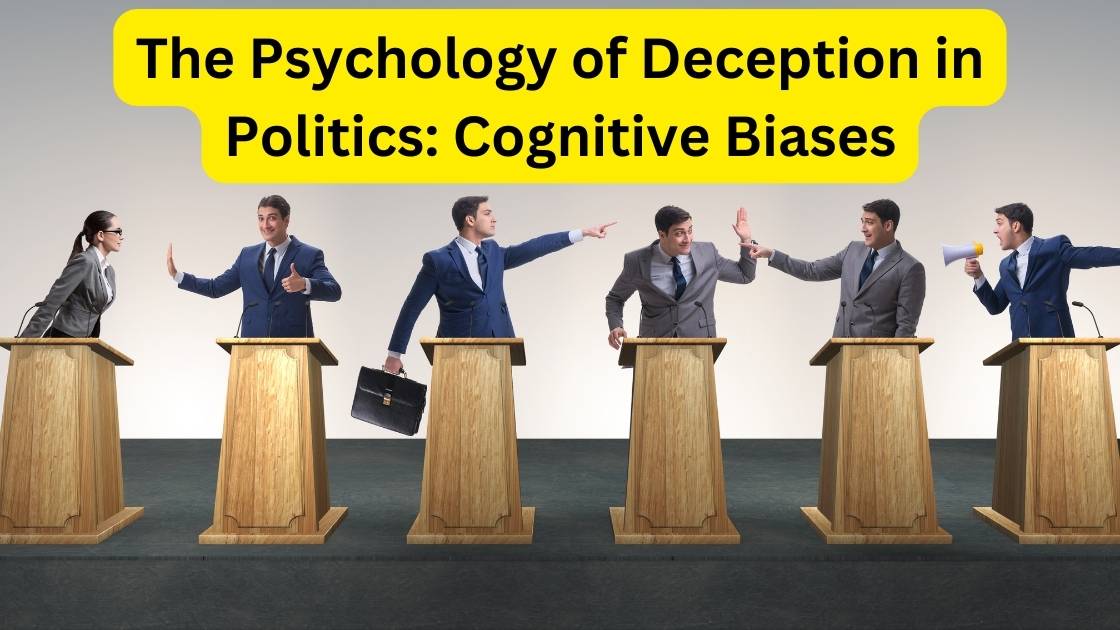
Deception is a complex and nuanced phenomenon that operates at the intersection of psychology and politics. In this section, we delve into the fundamental aspects of the psychology of deception, exploring the cognitive biases, in the following articles emotional manipulation, and the power of persuasion and social influence that contribute to the art of deception in politics.
Cognitive Biases: Influencing Political Beliefs and Decisions
Cognitive biases are inherent mental shortcuts and patterns of thinking that can significantly influence our political beliefs and decision-making processes. These biases often lead us to make judgments and decisions based on subjective interpretations rather than objective evidence. In the realm of the psychology of deception in politics, cognitive biases can be skillfully exploited to manipulate public opinion.
1. Confirmation Bias: Reinforcing Preexisting Beliefs
Confirmation bias plays a significant role in shaping political ideologies and beliefs. It refers to the tendency of individuals to seek out information that confirms their preexisting beliefs while disregarding or dismissing contradictory evidence. In the realm of the psychology of deception in politics, confirmation bias can have a profound impact on how people perceive and interpret political information.
1.1 The Influence of Confirmation Bias on Political Ideologies:
Confirmation bias is a cognitive bias that affects individuals’ information processing and decision-making. In the context of political ideologies, confirmation bias can lead to the following effects:
Selective Engagement with Information:
- Confirmation bias causes individuals to actively seek out information that supports their existing beliefs and values while ignoring or discounting information that contradicts them.
- People tend to gravitate towards sources of information that align with their political ideologies, such as news outlets, social media platforms, or online communities that reinforce their viewpoints.
- By selectively engaging with confirming information, individuals create a filter bubble around themselves, limiting their exposure to diverse perspectives and alternative viewpoints.
Reinforcement of Political Ideologies:
- Continuous exposure to confirming evidence reinforces individuals’ political ideologies and beliefs.
- When people encounter information that aligns with their preexisting views, it strengthens their convictions and solidifies their political identity.
- This reinforcement can contribute to the formation of a self-reinforcing cycle, where individuals actively seek out confirming information, leading to increased polarization and a decreased willingness to consider alternative perspectives.
Formation of Echo Chambers:
- Echo chambers refer to social environments where individuals surround themselves with like-minded individuals and sources of information that reaffirm their existing beliefs.
- Echo chambers can occur both offline and online, where people engage in discussions and interactions with those who share similar political ideologies.
- In echo chambers, dissenting opinions are often dismissed or ignored, reinforcing individuals’ own perspectives and creating a sense of tribalism.
The implications of confirmation bias on political ideologies are far-reaching. It can contribute to polarization, hinder constructive dialogue, and impede the formation of well-informed opinions. Overcoming confirmation bias requires individuals to actively seek out diverse perspectives, critically evaluate information, and challenge their own beliefs. Media literacy, exposure to a variety of viewpoints, and fostering open-minded discussions are crucial in mitigating the influence of confirmation bias and promoting a more informed and inclusive political discourse.
1.2 How Politicians Exploit Confirmation Bias to Cater to Specific Audiences:

Politicians are well aware of the influence of confirmation bias and often utilize it to their advantage in political communication. They employ various strategies to cater to specific audiences and exploit confirmation bias, including:
Crafting Messages to Align with Beliefs and Values:
- Politicians tailor their messages to align with the beliefs and values of their target audience.
- They emphasize policy positions and narratives that resonate with preexisting beliefs, aiming to create a sense of alignment between the audience’s values and their own campaign promises.
- By highlighting shared values and goals, politicians aim to establish a connection and gain support from individuals who already hold similar beliefs.
Utilizing Rhetoric, Slogans, and Narratives:
- Politicians employ persuasive rhetoric, catchy slogans, and compelling narratives that tap into the emotions and preconceived notions of their supporters.
- These communication techniques appeal to specific ideologies and reinforce preexisting beliefs, resonating with the audience’s biases and expectations.
- By using simple, memorable phrases or stories that align with their supporters’ worldview, politicians aim to evoke strong emotional responses and solidify their support base.
Presenting Information that Confirms Biases:
- Politicians often present information and data in a way that confirms the biases and expectations of their supporters.
- They may selectively highlight statistics, studies, or expert opinions that support their positions, while downplaying or disregarding conflicting evidence.
- By presenting information in a manner that reinforces their supporters’ preexisting beliefs, politicians seek to strengthen their appeal and maintain a positive perception among their target audience.
It is important to note that while politicians may exploit confirmation bias to cater to specific audiences, this practice raises ethical considerations. Manipulating confirmation bias can contribute to polarization, reinforce misinformation, and hinder critical thinking. It is crucial for citizens to be aware of these tactics, engage in critical analysis of political messaging, and seek out diverse perspectives to make informed decisions. Additionally, promoting transparency, integrity, and open dialogue in political communication can help mitigate the negative impacts of exploiting confirmation bias and foster a more inclusive and constructive political discourse.
1.3 Creating Echo Chambers and Disregarding Opposing Perspectives:
The formation of echo chambers is a significant consequence of confirmation bias in today’s digital age. Echo chambers refer to situations where individuals surround themselves with like-minded people and engage primarily with information that aligns with their existing beliefs. This can occur both online and offline, but online platforms and social media algorithms have exacerbated the phenomenon.
Echo Chambers and Like-Minded Individuals:
- In online spaces, individuals tend to connect with others who share similar political views and beliefs, forming closed communities of like-minded individuals.
- This can occur through social media platforms, online forums, or curated news sources that cater to specific ideological perspectives.
- By surrounding themselves with individuals who reinforce their beliefs, people may feel validated and secure in their own perspectives, further strengthening their existing ideologies.
Role of Social Media Algorithms and Personalized News Feeds:
- Social media platforms utilize algorithms that personalize users’ news feeds based on their past behavior, preferences, and interactions.
- These algorithms are designed to show users content that aligns with their interests and beliefs, creating a filter bubble that reinforces existing viewpoints.
- As a result, individuals may be exposed to a limited range of perspectives, missing out on diverse viewpoints and alternative narratives.
Dismissing Opposing Perspectives:
- In echo chambers, there is a tendency to dismiss or ignore opposing perspectives, as they challenge one’s preexisting beliefs.
- This can lead to polarization and a lack of constructive dialogue, as individuals become less receptive to alternative viewpoints or critical analysis.
- Dismissing opposing perspectives hinders the potential for open-mindedness, intellectual growth, and the ability to find common ground in political discussions.
The formation of echo chambers and the disregard of opposing perspectives pose significant challenges to democratic processes. They contribute to the polarization of society, hinder meaningful dialogue, and create an environment where misinformation and echo-chambered beliefs can thrive. To address this issue, it is essential for individuals to actively seek out diverse perspectives, engage in respectful and open conversations, and critically evaluate the information they encounter. Furthermore, fostering platforms and initiatives that promote cross-ideological dialogue and expose individuals to a range of viewpoints can help break down echo chambers and encourage a more inclusive and constructive political discourse.
2. Availability Heuristic: Distorting Perceptions

The availability heuristic is a cognitive bias that leads individuals to rely on information that is easily accessible or readily available in their memory when making judgments or decisions. In the context of the psychology of deception in politics, the availability heuristic can have a significant impact on how people form perceptions and make political judgments.
2.1 The Impact of the Availability Heuristic on Political Judgments:
The availability heuristic is a cognitive bias that influences our judgments and decision-making by relying on the ease with which relevant information comes to mind. In the realm of the psychology of deception in politics, the availability heuristic can have a significant impact on how people form their political judgments and attitudes.
Ease of Recall and Perceived Importance:
- The availability heuristic suggests that individuals tend to perceive information that is easily recalled as more important and valid.
- When evaluating political issues or candidates, people are more likely to rely on information that comes readily to mind, such as recent events or widely publicized incidents.
- This can lead to an overemphasis on certain aspects of politics while neglecting other important factors that may be less accessible in memory.
Weight Given to Vivid or Recent Events:
- The availability heuristic also influences the weight individuals to assign to vivid or recent events in their political decision-making.
- Emotionally charged events or incidents that receive significant media attention are more likely to be easily recalled and, therefore, considered more salient and impactful.
- The vividness and recency of such events can skew perceptions and overshadow more nuanced or less dramatic information.
Influence of Emotionally Charged Incidents or Anecdotes:
- Emotionally charged incidents or anecdotes have a powerful effect on shaping political attitudes and opinions.
- Personal stories or anecdotes that tap into individuals’ emotions can evoke strong responses and influence their judgments, often overshadowing objective data or broader policy considerations.
- Politicians and media outlets may strategically use emotionally charged narratives to shape public opinion and rally support for their positions.
The availability heuristic, particularly when combined with emotional appeals and vivid storytelling, can significantly influence political judgments and attitudes. However, it is essential to recognize its limitations and potential biases. To mitigate the impact of the availability heuristic, individuals can:
- Seek out diverse sources of information to ensure a balanced and comprehensive understanding of political issues.
- Engage in critical thinking and fact-checking to evaluate the validity and reliability of the information they encounter.
- Be mindful of the emotional impact of anecdotes or vivid events and consider the broader context and evidence before forming judgments.
- Foster a culture of media literacy and encourage a more nuanced understanding of political discourse.
By being aware of the availability heuristic and its potential effects, individuals can make more informed and rational political judgments, contributing to a healthier and more democratic political landscape.
2.2 Selective Presentation of Information by Politicians and Media Outlets:
The selective presentation of information by politicians and media outlets is a common practice that aims to shape public opinion and influence political narratives. This selective presentation can take several forms and has significant implications for the public’s understanding of political issues.
Highlighting Emotional and Attention-Grabbing Events:
- Politicians and media outlets often focus on specific events or narratives that evoke strong emotional responses from the public.
- These events are carefully selected to capture public attention and create an immediate impact, as they are more likely to be remembered and discussed.
- By highlighting emotionally charged incidents, politicians and media outlets can shape public opinion and steer the narrative in a particular direction.
Sensationalized News Stories:
- Media outlets sometimes prioritize sensationalized news stories that are designed to capture public attention and generate high viewership or readership.
- These stories may be dramatic, controversial, or scandalous, as they tend to elicit strong emotional reactions from the audience.
- The emphasis on sensationalized news can lead to an overrepresentation of certain topics or events and a neglect of more complex or nuanced issues.
Biased or One-Sided Presentation:
- Politicians and media outlets may present information in a biased or one-sided manner to reinforce preconceived notions or ideological perspectives.
- This can involve selectively highlighting evidence that supports a particular viewpoint while downplaying or omitting contradictory information.
- Biased presentation of information can lead to a distorted understanding of political issues and hinder constructive dialogue among the public.
To mitigate the impact of the selective presentation of information, individuals can:
- Seek out diverse sources of news and information to gain a more comprehensive understanding of political issues.
- Engage in critical thinking and fact-checking to evaluate the accuracy and reliability of the information presented.
- Look for multiple perspectives and consider alternative viewpoints to avoid falling into echo chambers.
- Encourage media organizations to uphold journalistic standards of objectivity, fairness, and balanced reporting.
By being aware of the selective presentation of information and actively seeking a well-rounded understanding of political issues, individuals can make more informed decisions and contribute to a more informed and engaged citizenry.
2.3 Distorted Perceptions and Their Influence on Political Attitudes:
Distorted perceptions have a significant influence on public opinion and political attitudes, shaping how individuals perceive and interpret political issues. These distorted perceptions can arise from various factors, including limited or biased information, reinforcement of existing biases, and the spread of misinformation.
Impact on Public Opinion and Political Beliefs:
- In the realm of deception in politics, distorted perceptions can shape public opinion by influencing how individuals perceive and interpret political information.
- Biased or limited information can lead to skewed understandings of complex issues and contribute to the formation of partisan beliefs.
- Distorted perceptions can reinforce preexisting biases, as individuals tend to seek out and engage with information that aligns with their existing beliefs.
Reinforcement of Existing Biases:
- Continuous exposure to limited or biased information can reinforce existing biases and lead to the entrenchment of political beliefs.
- Echo chambers, where individuals surround themselves with like-minded individuals and media sources, contribute to the reinforcement of biases.
- When individuals are exposed only to information that confirms their preexisting beliefs, it becomes challenging to consider alternative perspectives and engage in constructive dialogue.
Spread of Misinformation:
- In the context of the psychology of deception in politics, distorted perceptions can be fueled by the spread of misinformation, inaccurate or misleading information presented as factual.
- Inaccurate narratives deliberately or unintentionally propagated through various channels, can significantly impact public opinion.
- Misinformation can be amplified through social media platforms, where false or misleading information can spread rapidly and reach a wide audience.
Addressing distorted perceptions and their influence on political attitudes requires a multifaceted approach:
- Promoting media literacy and critical thinking skills to help individuals discern accurate information from misinformation.
- Encouraging fact-checking and verification of information from reliable sources.
- Holding media organizations accountable for providing accurate and unbiased information.
- Fostering open dialogue and respectful discussions that consider diverse perspectives.
By addressing distorted perceptions and promoting a more informed and critical approach to political information, individuals can contribute to a healthier and more constructive political discourse. Additionally, media organizations and policymakers play a crucial role in ensuring the dissemination of accurate information and combating the spread of misinformation.
3. Other Cognitive Biases in Politics

In addition to confirmation bias and the availability heuristic, there are several other cognitive biases that influence political beliefs and shape political discourse. Understanding these biases is crucial for recognizing the potential manipulation and deception in political communication.
3.1 Anchoring Bias: Influence of Initial Information
Anchoring bias refers to the cognitive bias where individuals rely heavily on the first piece of information they encounter when making judgments or decisions. This bias can significantly influence subsequent perceptions and negotiations, including in the realm of deception in politics. Politicians often strategically set an anchor point to shape public opinion and influence policy discussions in their favor.
Influence of Initial Information:
- When people are presented with an initial piece of information, it serves as a reference point that influences their subsequent judgments and decisions.
- The initial information can create a mental benchmark against which other information is compared, leading to a bias in favor of the anchor point.
Strategic Use by Politicians:
- Politicians can strategically set an anchor point to shape public perception and policy discussions.
- By presenting an extreme or ambitious initial proposal, politicians can influence the range of acceptable outcomes and make subsequent compromises seem more favorable.
- This tactic is often used in negotiation processes to position oneself advantageously and sway the final outcome in their favor.
Examples in Political Campaigns:
- Setting a high initial policy proposal: Politicians may propose ambitious policies or funding amounts as a starting point, knowing that they will likely need to negotiate and compromise. This anchors the public’s perception and makes subsequent compromises appear more reasonable and favorable.
- Presenting extreme scenarios: Politicians may use extreme scenarios or worst-case examples to emphasize the importance of their agenda, thereby anchoring public opinion toward their proposed solutions.
- Highlighting contrasting options: Politicians may strategically present options that are positioned at opposite ends of a spectrum, anchoring public perception toward a preferred option while making it seem more moderate or reasonable in comparison.
Understanding the influence of anchoring bias in political campaigns is crucial for both voters and policymakers. Recognizing this bias can empower voters to critically evaluate initial information presented to them and consider a broader range of options. Policymakers and negotiators need to be mindful of the potential impact of anchoring bias and ensure that policy discussions are based on a comprehensive analysis rather than being solely driven by the initial anchor point.
By being aware of anchoring bias and its influence, individuals can strive for more informed decision-making, engage in constructive dialogue, and avoid being unduly swayed by initial information presented in political campaigns.
3.2 Framing Effect: Influence of Presentation
The framing effect refers to the cognitive bias where the way information is presented or framed can significantly influence decision-making and perception. In the psychology of deception in politics, politicians often use framing techniques to shape public perception and influence opinion on various issues.
Influence of Presentation:
- The way information is presented or framed can influence how individuals perceive and evaluate it.
- Different frames can evoke different emotional responses, shaping the way people interpret and make judgments about the information.
- The framing effect demonstrates that individuals are not solely influenced by the content of information but also by how it is presented.
Strategic Use by Politicians:
- Politicians strategically frame issues to shape public perception and influence opinion in their favor.
- By using specific frames, politicians can emphasize certain aspects of an issue, highlight its significance, and guide public understanding.
- Framing can be used to evoke specific emotions, align with preexisting beliefs, or present policies in a favorable light.
Examples in Political Communication:
- Economic framing: Politicians may emphasize the economic benefits or consequences of a policy to sway public opinion. For example, framing a policy as creating jobs and stimulating economic growth can make it more appealing to the public.
- Social framing: Politicians may frame an issue in terms of its social impact, focusing on issues such as justice, equality, or public safety. This framing can evoke emotional responses and influence public opinion based on individuals’ values and beliefs.
- Security framing: Politicians may frame policy proposals in terms of national security, emphasizing the potential threats or risks involved. This framing can shape public perception and garner support by appealing to concerns about safety and protection.
Understanding the framing effect is crucial for voters to critically analyze political messages and evaluate the underlying information beyond its presentation. By recognizing framing techniques, individuals can be more aware of potential biases and strive for a more comprehensive understanding of the issues at hand.
Furthermore, it is essential for citizens to engage in media literacy and critical thinking to recognize framing and consider multiple perspectives on political issues. By actively seeking diverse sources of information and questioning the framing used by politicians and media outlets, individuals can make more informed decisions and contribute to a more nuanced and constructive political discourse.
3.3 Bandwagon Effect: Influence of Social Proof
The bandwagon effect refers to the cognitive bias where individuals are inclined to adopt certain beliefs or behaviors simply because they perceive them to be popular or widely accepted. In the psychology of deception of politics, the bandwagon effect can significantly influence public opinion and decision-making.
Influence of Social Proof:
- The bandwagon effect is rooted in the human tendency to conform to the perceived consensus or popularity of a belief or behavior.
- When individuals see others supporting a particular political candidate, policy, or idea, they may feel compelled to join the bandwagon to align themselves with the prevailing sentiment.
Strategic Use by Politicians:
- Politicians leverage the bandwagon effect to create a sense of momentum and inevitability around their campaigns or policy proposals.
- By emphasizing endorsements from influential individuals or showcasing public support, politicians aim to convey a perception of broad consensus and popularity.
- The goal is to make individuals feel more inclined to support the candidate or policy based on the belief that it is the winning or widely accepted choice.
Examples in Political Campaigns:
- Highlighting endorsements: Politicians often publicize endorsements from prominent figures, celebrities, or respected organizations to create a bandwagon effect. The idea is to showcase that influential individuals or groups support the candidate, thus influencing the perception that the candidate is the favorable or popular choice.
- Showcasing public support: Politicians may emphasize the size of their rally attendance, the number of social media followers, or the volume of campaign donations to create a sense of widespread support. This can foster a bandwagon effect by giving the impression that many people are already backing the candidate or cause.
Awareness of the bandwagon effect is crucial for voters to engage in independent thinking and make decisions based on their own values and critical analysis. By recognizing the influence of social proof, individuals can challenge the assumption that popularity equates to the correctness or validity of a political stance. It is important for voters to evaluate candidates and policies based on their merits, alignment with personal values, and the evidence supporting their positions.
Promoting media literacy, encouraging critical thinking, and fostering a culture of independent decision-making can help counter the bandwagon effect. By encouraging individuals to consider multiple perspectives, examine evidence, and evaluate candidates based on their qualifications and policy proposals, the influence of the bandwagon effect can be mitigated, allowing for more informed and independent decision-making.
3.4 Halo Effect: Influence of Overall Impression
The halo effect is a cognitive bias where our overall impression of a person or entity influences our perception of their specific traits or qualities. In the psychology of deception in politics, the halo effect can play a significant role in shaping public opinion and attitudes toward political candidates.
Influence of Overall Impression:
- The halo effect occurs when individuals form a positive or negative opinion about a person based on a single characteristic or initial impression.
- If we have a positive overall impression of a political candidate, we tend to view their specific traits, accomplishments, or personal narratives in a favorable light, even if they may have shortcomings or inconsistencies.
Creating a Favorable Overall Impression:
- Politicians strategically present themselves in a way that creates a positive overall impression in the minds of voters.
- They emphasize specific traits, accomplishments, or personal narratives that are likely to evoke positive emotions or associations.
- By doing so, politicians aim to influence the perception of their entire character, competence, or policy positions based on a few appealing qualities.
Examples in Political Campaigns:
- Symbolic associations: Politicians often associate themselves with positive symbols, such as national pride, popular social causes, or historical figures, to create a halo effect. The positive connotations of these symbols can transfer onto the candidate, leading voters to perceive them more favorably overall.
- Appealing qualities: Politicians highlight specific qualities or accomplishments that are likely to resonate with voters. These may include traits like charisma, leadership, or relatability, or accomplishments such as past successes or experiences that showcase competence and credibility.
- Personal narratives: Politicians often share personal stories or anecdotes that create an emotional connection with voters. These narratives can evoke empathy, admiration, or identification, contributing to a positive overall impression.
It is important for voters to be aware of the halo effect and to evaluate political candidates based on a comprehensive understanding of their qualifications, policy positions, and track records. By critically examining candidates’ specific traits, accomplishments, and policy proposals, voters can make informed decisions that are not solely influenced by the overall impression created through the halo effect.
Promoting media literacy and encouraging voters to engage in independent research, fact-checking, and critical analysis can help mitigate the influence of the halo effect. By looking beyond superficial impressions and considering multiple dimensions of a candidate’s character and policies, voters can make more informed choices based on substance rather than relying solely on the halo effect.